




An air conditioner does more than cool or heat a room. Behind stable indoor temperatures and efficient HVAC operation is a continuous process of temperature measurement, signal processing, and equipment control. At the beginning of this process is the air conditioner temperature sensor.
Temperature sensors provide the HVAC controller with information about room temperature, heat exchangers, and other critical components. The controller uses this information to adjust system operation and maintain the desired temperature.
Choosing the right sensor involves more than matching its physical dimensions. Resistance characteristics, response time, installation location, wiring, environmental conditions, and controller compatibility all affect performance.
This guide explains how air conditioner temperature sensors work, where they are used, why NTC thermistors are common in HVAC systems, how to test them, and what to consider when selecting a sensor for OEM and ODM applications.
What Is an Air Conditioner Temperature Sensor?
An air conditioner temperature sensor is a component that detects temperature and converts it into an electrical signal that an HVAC controller can interpret.
The sensor does not normally control the compressor directly. Instead, it provides temperature feedback to the controller.
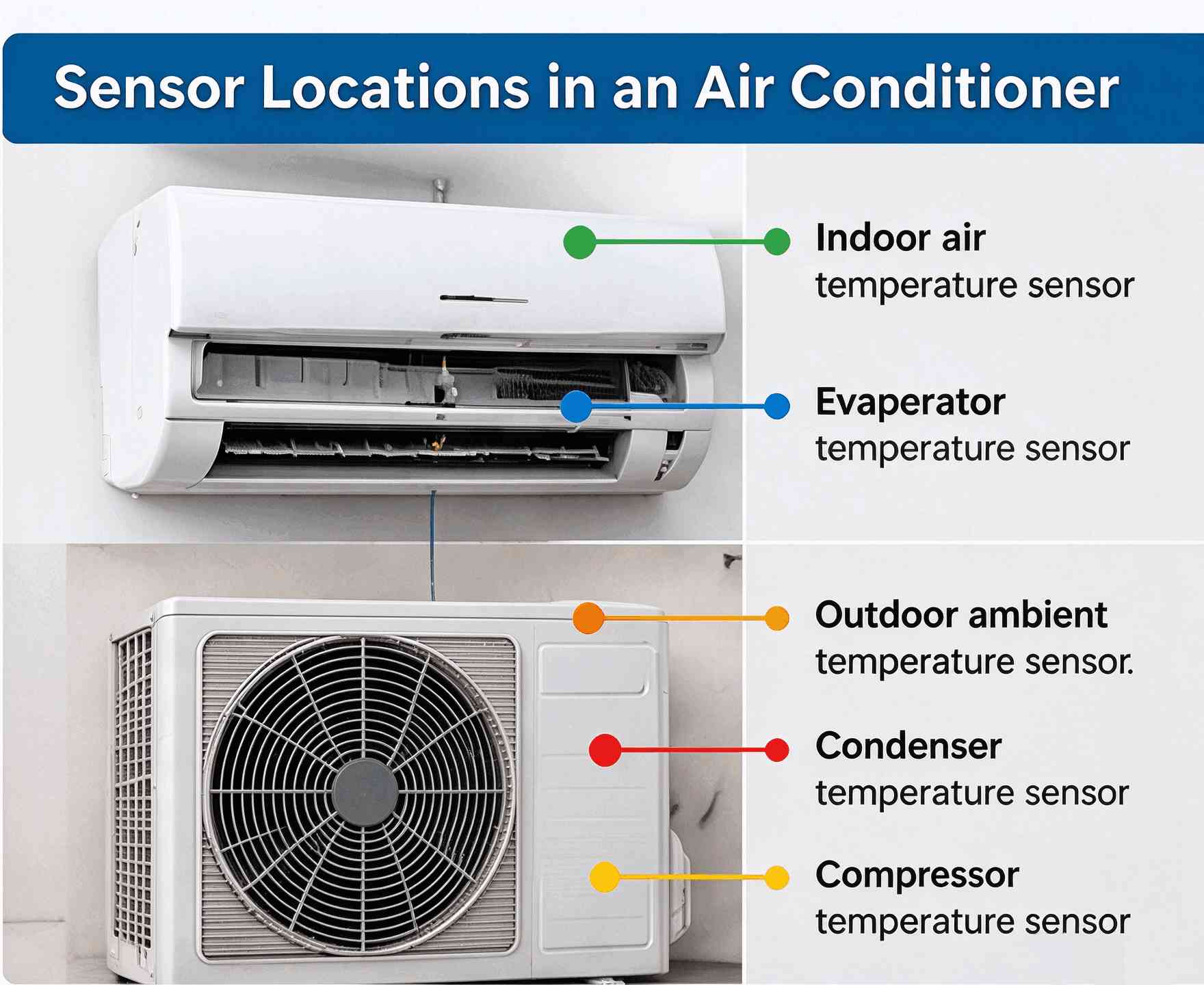
A simplified control process is:
Temperature → Sensor → Electrical Signal → Controller → System Response
Depending on the system design, an air conditioner may contain several sensors, including:
Indoor air temperature sensors
Evaporator temperature sensors
Condenser temperature sensors
Outdoor ambient temperature sensors
Compressor-related temperature sensors
Supply-air temperature sensors
Each sensor serves a specific purpose. Sensors installed in different locations may require different electrical specifications and mechanical structures.
Why Temperature Sensors Matter in HVAC Systems
Temperature sensors support several important functions in air conditioning equipment.
Temperature Regulation
Indoor temperature sensors provide feedback that allows the controller to compare the actual room temperature with the target setpoint and adjust cooling or heating operation.
Compressor and Fan Control
Temperature readings can help the controller regulate compressor operation, adjust fan speed, and optimize system performance, depending on the control architecture.
Heat Exchanger Monitoring
Evaporator and condenser sensors monitor thermal conditions and provide information for cooling control, frost-related protection, and heat dissipation management.
System Protection
Temperature feedback can help identify abnormal operating conditions and support protective functions when a monitored component reaches a specified temperature.
Reliable sensing helps improve control accuracy and system stability.
How Does an Air Conditioner Temperature Sensor Work?
The working principle depends on the sensing technology. NTC thermistors are widely used in air conditioning and refrigeration applications.
An NTC thermistor has a negative temperature coefficient, meaning its resistance decreases as temperature increases.
Temperature increases: Resistance decreases.
Temperature decreases: Resistance increases.
The controller measures the resistance and converts it into a temperature value using the sensor's resistance-temperature characteristics.
The relationship is nonlinear, so the controller must be compatible with the specific sensor specification.
Other sensor technologies work differently:
RTD: Measures temperature through the predictable resistance change of a metallic sensing element.
Thermocouple: Measures temperature using the thermoelectric voltage generated by two different metals.
Selecting the correct sensing technology is essential for reliable temperature feedback.
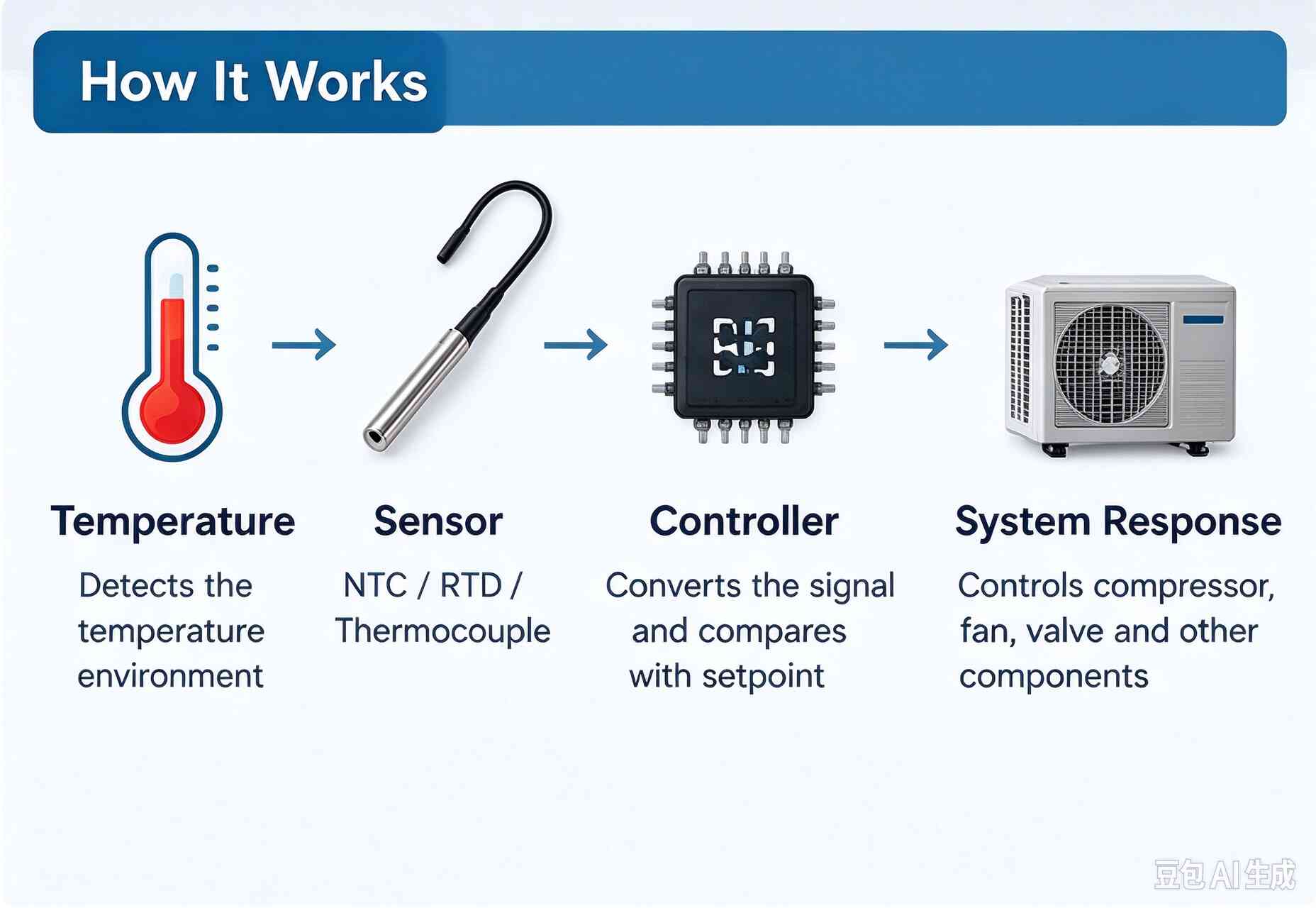
Common Temperature Sensor Locations in an Air Conditioner
Installation location directly affects measurement accuracy and sensor performance.
Indoor Air Temperature Sensor
Measures room or return-air temperature for comfort control and temperature regulation. It should be positioned away from direct sunlight and localized heat sources whenever possible.
Evaporator Temperature Sensor
Monitors the evaporator coil temperature and may support cooling control, frost-related protection, and system diagnostics. Its construction should suit condensation, temperature cycling, and limited installation space.
Condenser Temperature Sensor
Monitors the outdoor heat exchanger and provides feedback for fan control, heat dissipation management, and temperature-related protection.
Compressor Temperature Sensor
Monitors the temperature of the compressor or related components in systems that require dedicated thermal monitoring.
Outdoor Ambient Temperature Sensor
Measures outdoor air temperature to support HVAC operation under changing environmental conditions.
Why NTC Thermistors Are Common in Air Conditioning
NTC thermistors are widely used because they combine high temperature sensitivity with compact size and economical construction.
Key advantages include:
High sensitivity to temperature changes
Fast thermal response in suitable designs
Compact sensing elements
Flexible resistance and B-value options
Simple electrical integration
Cost-effective manufacturing
Multiple probe and mounting configurations
Common NTC temperature sensor constructions include stainless steel probes, plastic housings, epoxy-coated elements, cable assemblies, mounting clips, and customized connectors.
These options make NTC thermistors suitable for residential air conditioners, commercial HVAC equipment, heat pumps, and refrigeration systems.
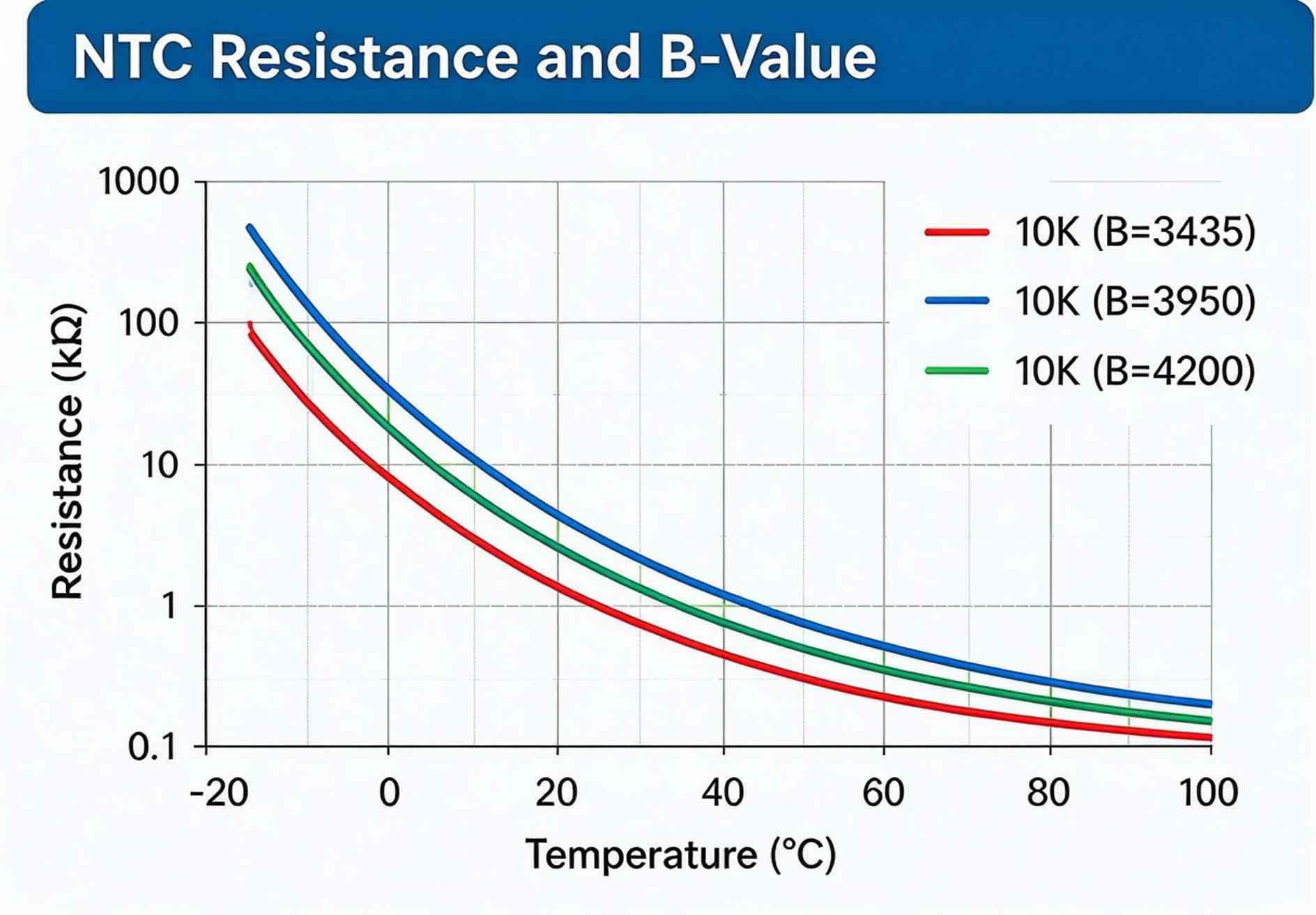
Understanding NTC Resistance and B-Value
Resistance and B-value are two critical specifications when selecting an NTC temperature sensor.
Nominal Resistance
Nominal resistance describes the resistance at a specified reference temperature.
For example, a 10K NTC thermistor at 25°C has a nominal resistance of 10 kΩ at 25°C. Its resistance will be higher at lower temperatures and lower at higher temperatures.
Therefore, an NTC sensor should not be expected to maintain the same resistance throughout its operating range.
B-Value
The B-value describes the relationship between resistance and temperature over a specified range.
Two NTC sensors may have the same nominal resistance at 25°C but different B-values. Their resistance-temperature curves may therefore differ.
A simplified beta equation is:
R = R₀ × exp[B × (1/T − 1/T₀)]
Where:
R = Resistance at the measured temperature
R₀ = Resistance at the reference temperature
B = Thermistor B-value
T = Absolute measured temperature in kelvin
T₀ = Absolute reference temperature in kelvin
B-value specifications may include B25/50 or B25/85. When selecting a replacement sensor, engineers should verify the nominal resistance, B-value, tolerance, and resistance-temperature curve rather than matching only one resistance value.
Resistance-Temperature Curve
The resistance-temperature curve, often called the R-T curve, defines how an NTC thermistor's resistance changes across its operating range.
An accurate R-T curve helps engineers configure the controller to interpret the sensor signal correctly.
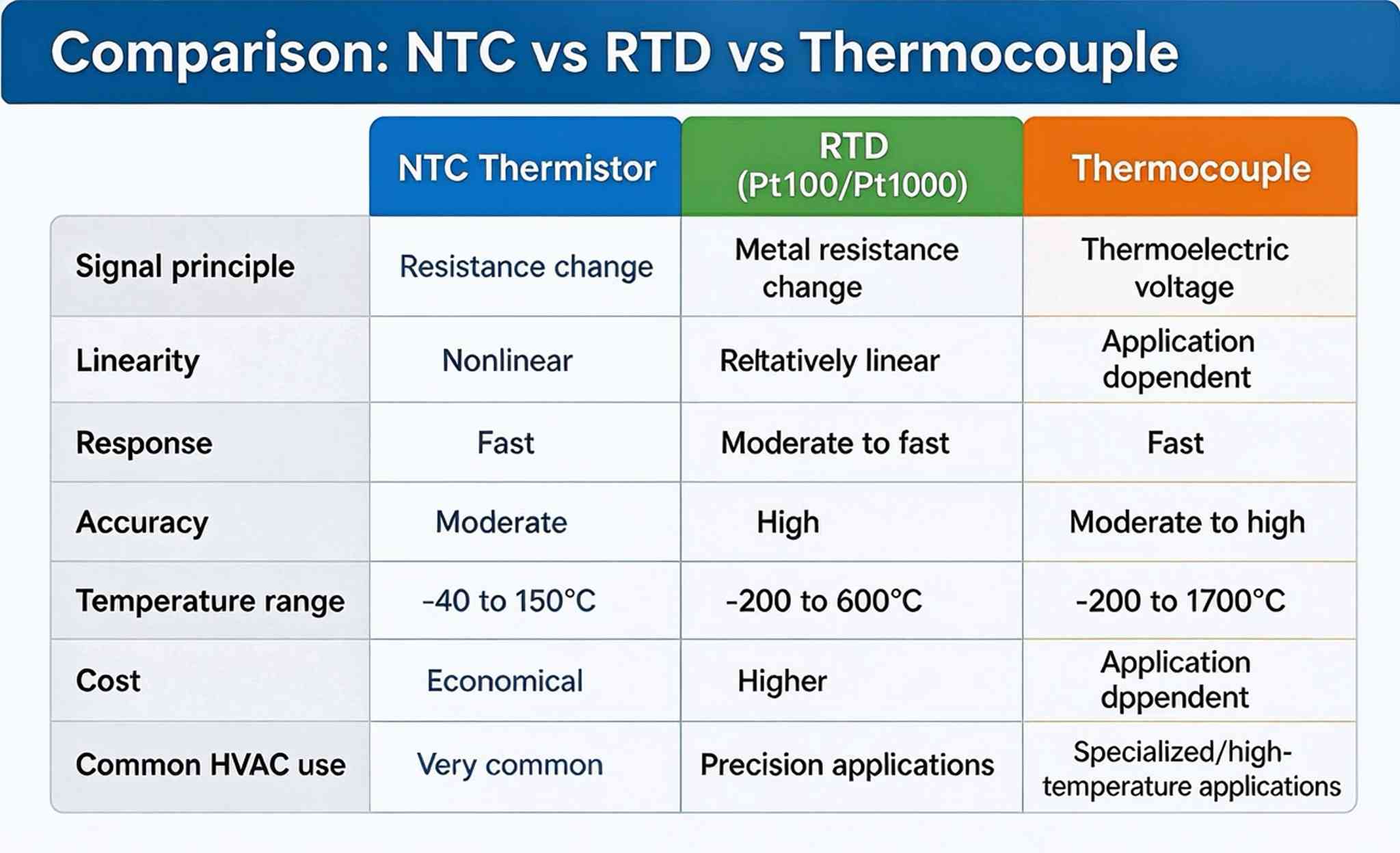
NTC vs. RTD vs. Thermocouple for HVAC
Different applications require different sensing technologies.
| Characteristic | NTC Thermistor | RTD | Thermocouple |
| Measurement principle | Resistance change | Metal resistance change | Thermoelectric voltage |
| Common applications | Air conditioning and refrigeration | Precision HVAC and industrial measurement | High-temperature and specialized measurement |
| Key advantage | High sensitivity and economical design | Accuracy and stabilit | Wide temperature capability |
| Linearity | Nonlinear | Relatively linear | Dpends on thermocouple type |
| Selection priority | Resistance, B-value, R-T curve | Element type, accuracy, stability | Thermocouple type and temperature range |
NTC thermistors are a common choice for general HVAC temperature measurement. RTDs may be preferred where accuracy and stability are priorities, while thermocouples are useful for specialized high-temperature applications.
The best choice depends on the equipment requirements and controller design.
How Temperature Sensors Affect Compressor and Fan Control
A temperature sensor is part of a larger feedback control loop. It supplies information to the controller, which determines how the system should respond.
The process typically follows these steps:
Temperature changes.
The sensor detects the change.
The electrical signal changes.
The controller interprets the signal.
The controller compares the measured condition with programmed parameters.
The compressor, fan, valve, or heating components respond.
The temperature changes again.
The sensor provides updated feedback.
This process continues while the system operates.
A sensor with unsuitable resistance characteristics, excessive response delay, poor installation, or unstable wiring can introduce errors into the control process. Sensor selection and installation therefore influence overall control performance.
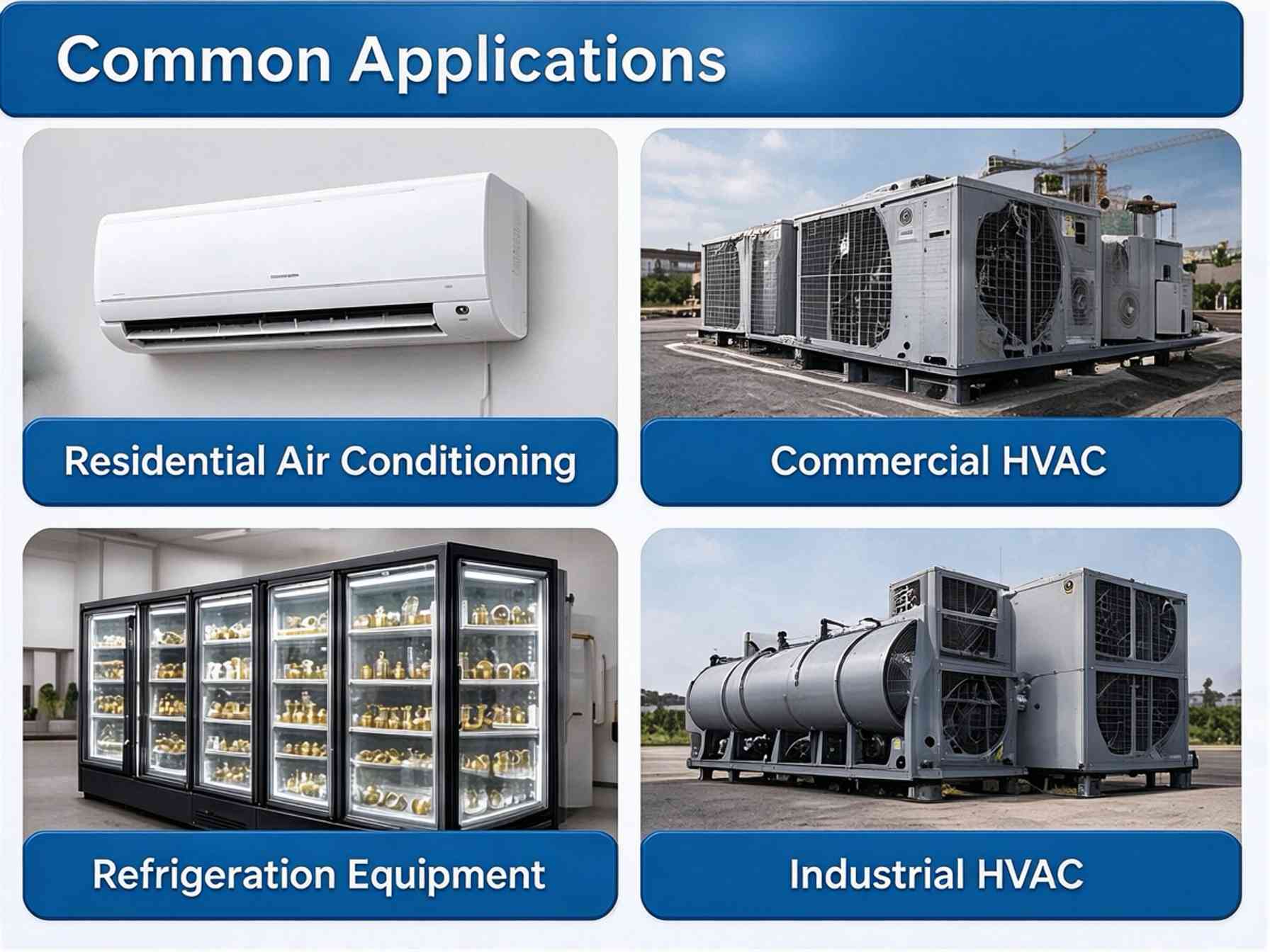
Common Applications of Air Conditioner Temperature Sensors
Air conditioner temperature sensors are used across multiple HVAC and cooling applications.
Residential air conditioning: Split systems, wall-mounted units, portable air conditioners, and heat pumps.
Commercial HVAC: Central air conditioning, rooftop units, air handling systems, and building climate control.
Refrigeration: Display refrigerators, commercial freezers, cold storage systems, and refrigeration units.
Industrial HVAC: Industrial cooling equipment and systems requiring customized probes, cable assemblies, or mounting structures.
Different applications may require different temperature ranges, response times, environmental protection, and electrical characteristics.
How to Test an Air Conditioner Temperature Sensor
Testing should follow the equipment manufacturer's service procedures. For resistance-based sensors, a multimeter can help identify common faults.
Step 1: Identify the Sensor
Determine whether the sensor measures room temperature, evaporator temperature, condenser temperature, or another condition.
Step 2: Inspect the Sensor
Check the probe, housing, cable, connector, and mounting structure for cracks, corrosion, broken wires, or moisture damage.
Step 3: Disconnect the Sensor
Where appropriate, disconnect the sensor from the control circuit before measuring resistance.
Step 4: Measure Resistance
Use a suitable multimeter to measure the sensor resistance under a known temperature condition.
Step 5: Compare With the Datasheet
Compare the measured value with the manufacturer's resistance-temperature table or R-T curve. Remember that NTC resistance changes with temperature.
Step 6: Check Wiring and Connectors
If the sensor resistance is within specification but the controller receives an incorrect signal, inspect the wiring harness, connector pins, terminals, and controller input.
How to Choose the Right Air Conditioner Temperature Sensor
Selecting the right sensor requires evaluating both electrical and mechanical requirements.
Electrical Specifications
Confirm the following:
Sensor type: NTC, RTD, or thermocouple
Nominal resistance and reference temperature
B-value and R-T curve, where applicable
Resistance tolerance or measurement accuracy
Operating temperature range
Controller compatibility
Mechanical Design
Consider:
Probe diameter and length
Probe material
Mounting method
Thread or clip specifications
Cable length and insulation material
Connector and terminal configuration
Environmental Conditions
Evaluate exposure to humidity, condensation, dust, vibration, temperature cycling, and other environmental factors.
Response Time
Choose a response time appropriate for the application. Actual thermal response depends on the sensing element, probe structure, installation method, airflow, and surrounding material.
A sensor that looks identical to the original component may still produce incorrect readings if its electrical characteristics are incompatible with the controller.
Custom Air Conditioner Temperature Sensors for OEM and ODM Projects
HVAC manufacturers may require customized sensors to fit specific equipment designs and control systems.
OEM and ODM customization may include:
Sensing element: Nominal resistance, B-value, tolerance, and R-T characteristics.
Probe design: Dimensions, material, shape, and thermal contact requirements.
Cable assembly: Cable length, insulation, routing, and connector configuration.
Mounting structure: Clips, brackets, threaded designs, and other installation features.
Environmental requirements: Temperature range, humidity exposure, vibration, and other operating conditions.
The objective is to develop a sensor that integrates correctly with the complete HVAC system, rather than simply selecting a component based on appearance.
Common Air Conditioner Temperature Sensor Problems
Temperature control issues do not always indicate sensor failure.
| Problem | Possible Causes |
| Incorrect temperature reading | Wrong sensor specification, resistance drift, poor placement, or controller error |
| Open circuit | Broken cable, damaged connector, or internal sensor failure |
| Short circuit | Damaged wiring, connector fault, or internal failure |
| Unstable signal | Loose connections, intermittent contact, electrical interference, or damaged wiring |
| Incorrect replacement sensor readings | Incompatible resistance, B-value, R-T curve, or controller interface |
A complete diagnosis should evaluate the sensor, wiring, connectors, and controller before replacing components.
Air Conditioner Temperature Sensor Selection Checklist
Before ordering or developing a temperature sensor, engineers should confirm the following specifications.
| Parameter | Key Requirement |
|---|---|
| Sensor type | NTC, RTD, or thermocouple |
| Nominal resistance | Required resistance at the reference temperature |
| B-value | Required B-value and reference points |
| Temperature range | Minimum and maximum operating temperatures |
| Accuracy | Required measurement tolerance |
| Response time | Required thermal response |
| Probe | Size, material, and structure |
| Mounting | Installation method and dimensions |
| Cable | Length, material, and insulation |
| Connector | Connector or terminal type |
| Environment | Humidity, condensation, vibration, and other conditions |
| Controller | Compatibility with the electrical input and control logic |
This checklist helps reduce compatibility issues during product development and sensor replacement.
Conclusion
Air conditioner temperature sensors play an important role in HVAC temperature measurement, equipment control, and system protection. By providing feedback from the room, evaporator, condenser, and other measurement points, they help controllers make appropriate operating decisions.
NTC thermistors are widely used because they offer high sensitivity, compact construction, and flexible electrical and mechanical configurations. However, nominal resistance alone is not enough to determine compatibility. B-value, R-T characteristics, temperature range, installation location, wiring, and controller requirements must also be considered.
For OEM and ODM projects, selecting or customizing the right temperature sensor can help improve integration, measurement reliability, and overall HVAC system performance.
Manufacturers should evaluate the complete application before finalizing a sensor specification, ensuring that electrical characteristics, mechanical design, and environmental requirements align with the intended equipment.

Expert for Thermistors Temperature Sensors Humidity Sensors Level Sensors ; Reliable but flexible custom products development
100+ Sensing Solutions Developed Annually for Different Applications
80+ Countries Customers Serviced


